
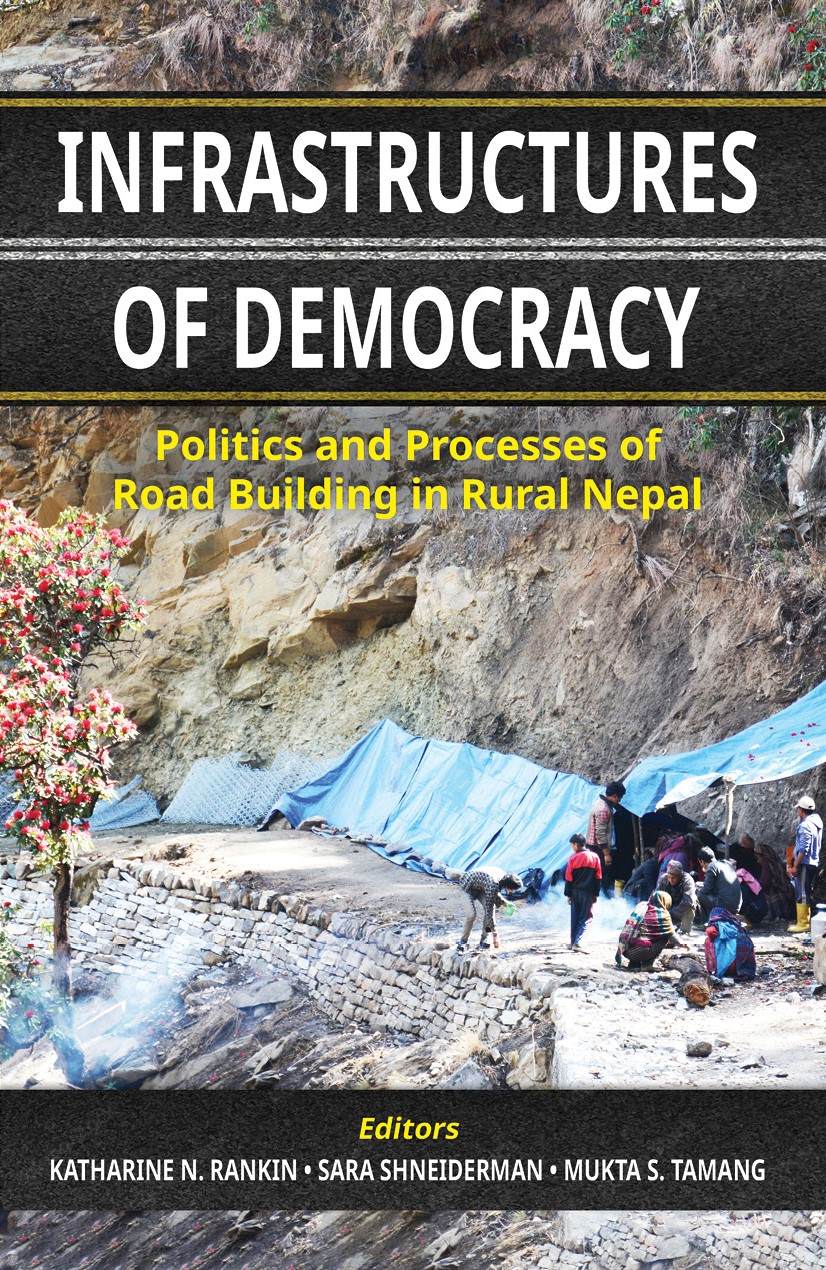
Description
Infrastructures of Democracy is a vivid and original set of studies showing how Nepal’s rural roads are more than infrastructure— they are contested terrains of politics, power, and everyday life. Sensitive to local voices and vernaculars, the authors rethink development and open new pathways towards imagining the possibilities of a just society.
Edward Simpson, Lancaster University
A collaborative endeavor of Canada and Nepal-based academics, Infrastructures of Democracy is an important ethnographic volume on the roads of Nepal, written in a lucid and evocative style. Moving away from mega-roads and highways, this book scales locally to district and agricultural roads, focusing attention on the agentive role of rural roads in shaping both statecraft and political subjectivity.
Swargajyoti Gohain, Ashoka University
Infrastructures of Democracy is useful for understanding how the planning and implementation of different modalities of road construction in rural Nepal take place. It is fascinating to read how formal and informal planning for district roads is shaped by the power and influence of political parties eventually leading to burdens for the marginalized people, high levels of corruption among those involved in the nexus, and poor quality of roads. It gives hints to how social justice can be promoted in road building.
Jagannath Adhikari, Author of Food Crisis in Karnali
Katharine N. Rankin is Professor in the Department of Geography and Planning at the University of Toronto, Canada.
Sara Shneiderman is Associate Professor in the Department of Anthropology and School of Public Policy & Global Affairs at the University of British Columbia, Vancouver, Canada.
Mukta S. Tamang is Lecturer in the Central Department of Anthropology at Tribhuvan University, Kathmandu, Nepal.


Reviews
There are no reviews yet.