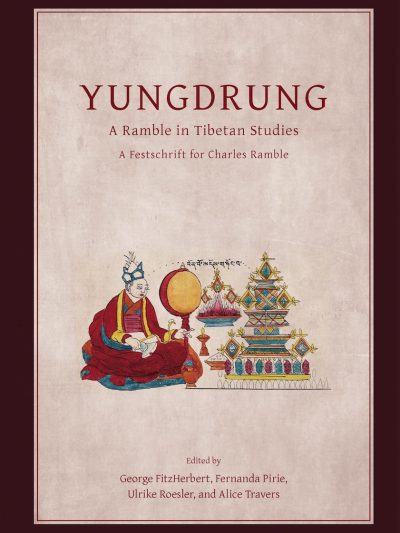
Description
From the Preface
Dr Tim Myatt
(Oxford)
One has to start somewhere: let me begin by reminding you that one long evening Charles translated Freddie Mercury’s operatic prog-rock ballad Bohemian Rhapsody into Tibetan—now, where do we go from there? Is this the real life? Is this just fantasy?
Charles was, until his Oxford retirement, the founder, heart, and animating genius of the Tibetan & Himalayan Studies programme. This was founded within Oxford’s Oriental Institute (as was), and was turned, by Charles’ sheer force of personality and will, into an impossible and unlikely success. The central point is Wolfson College, where Charles’ centripetal force spun an extraordinary collection of interested people harmoniously into the orbit of his proto-faculty.
From the first DPhil student, then two MPhil students (myself included), that cyclonic force attracted others, gathering in strength and numbers. There was a retired Army General and Gurkha commander; there were hippies, no longer in the first flush of youth, who had spent decades in Kathmandu; there were ferocious, fit and focused Americans who arrived with a smattering of Tibetan. There were quasi-aristocratic Central Europeans already well versed in Sanskrit with the odd spot of Pali; historians, linguists, anthropologists, archaeologists, and those interested in the religions of the roof of the world. And spooks, yes of course there were early-career spooks, and the occasional mid-career spook on a refresher: in moderation spooks can add distinction to any gathering.
If this sounds like the formation of an idiosyncratic élite, it was tempered by Charles’ wholly unconventional take on students with potential—his genius for identifying people who’d benefit from an albeit small, but deep, subject and from personal attention. And he never confused potential with conventional educational attainment. Nor did he care in the slightest if his students were billionaires or from more modest backgrounds. He called on them in their chateaus, and kept a kindly eye on those working in the shabbier cafes and bars of East Oxford to fund their studies: all were treated alike, all that mattered to Charles was that you learned, were loyal to the programme, and you tried your best.
The sheer range which Charles can cover in the study of all things Tibetan is breathtaking: at one point early on he was supervising research degrees on Tibetan Dunhuang manuscripts of the 8th century, 19th century Anglo-Tibetan relations, and a contemporary Tibetan monk’s writings on Western philosophy. And all of us taught by the same person, with equal confidence, knowledge, and dash. One of his early students recalls that, ‘Charles was as close as one could get to a real-life Indiana Jones, although that may have been thanks to the silly hat he had a habit of wearing. Thankfully there was no whip.’
How to characterise Charles and his circle in those years when we were all inhabiting an enchanted version of North Oxford. An early friend puts it well: ‘Part of his charismatic appeal is due to his immense knowledge, experience and intelligence always going together with generosity, humour and charm, making him a great friend and companion, as well as an excellent teacher and scholar. Quite simply Charles is always irresistible company.’ Charisma comes in many different forms, yet eludes easy definition or explanation. For one student, ‘Charles’ charisma is of a particularly rare type, one in which charm and appeal are grounded in generosity, kindness, and willingness to help others.’
Charles as he appeared in those years (and he has not changed so very much since then), was strong-built and active, with his long hair tied back into a pony tail with a velvet band: sturdy as an early enlightenment English squire, looks according with a name which could easily be that of the eponymous hero of a rattling 18th-century novel, let us say The Life and Adventures of Charles Ramble Esq. Charles maintains something of this appearance even at late hours, perhaps for example in a quietly respectable Rhineland town, and in circumstances liable to dishevel lesser mortals: the collar of the shirt might be unbuttoned and the tie loosened, but still in the early hours of the morning, he is emphatically wearing a shirt and tie.
Perhaps those gatherings were occasionally fuelled by one glass (red, French) too many? His circle evolved into a peregrinatory seminar, a conversation roving and rambling. You would learn all night, and attempt classes the next day: Charles was a believer in learning by osmosis (a theory yet to be proven), so there were evenings when you could only speak Tibetan—evenings of singing—in the College Bar at Wolfson, or Wyndham Way. Or, unforgettably, in the Rose and Crown in North Oxford, where Andrew, the accommodating landlord, put a piano at our disposal and the singing could last until we fell out into the quiet street at an unfeasibly late hour, into that narrow thoroughfare of shuttered clothes shops, closed cafes and brick garden walls with low doors. Charles’ musical tastes were extraordinarily broad: he would sing popular songs that had lodged themselves in his memory, but he would also sing grave and ancient Scottish ballads, French popular and traditional songs; Tibetan hunting songs; Nepalese love ballads; Bollywood hits, and often in a round. He could sing, in his fine baritone, in at least a dozen languages. There are countless recollections and memories from myself and others of these formative years, and may these ‘ever be in their flowing cups freshly remember’d’.
Charles and his brilliantly empathetic wife, Anne de Sales, in her own right a considerable scholar of Nepalese, lived on Linton Road just up from the College, in a house stuffed and scattered with books. The material culture of the Himalayas was expressed by the objects dotted amongst the piles of books, by the leopard skins draped over the bannisters of the staircase. If you were late or too early for a seminar or conversation, you were always welcome to turn up and be fed, or snooze on the sofa surrounded by the slight scent of sandalwood. That quiet scent clung to Charles, the smell of the sub-continent of his birth, and from the places which were more present in his mind than the rainy and learned avenues of North Oxford. If ever a scholar “got off the veranda” (in Bronisław Malinowski’s classic phrase) it was Charles. He carried us with him, and what follows is but a small gesture of thanks and appreciation for our guide.